 Bill My Car
RTO & Ownership Transfer
Form 30 RTO Generator (Fill & Download PDF)
For Car and Bike Dealers in India
Start free →Fill and download Form 30 in seconds, free and with no login. Type your details into the fields below and download a ready-to-sign, RTO compliant PDF application for transfer of ownership. It follows the official CMVR Form 30 format, Part I and Part II, used to transfer a used car's ownership in India, works just as well for a bike, truck or any other registered vehicle, and doubles as a free Form 30 format and template you can reuse.
Here is a filled sample of Form 30, showing Part I (transferor) and Part II (transferee) completed:
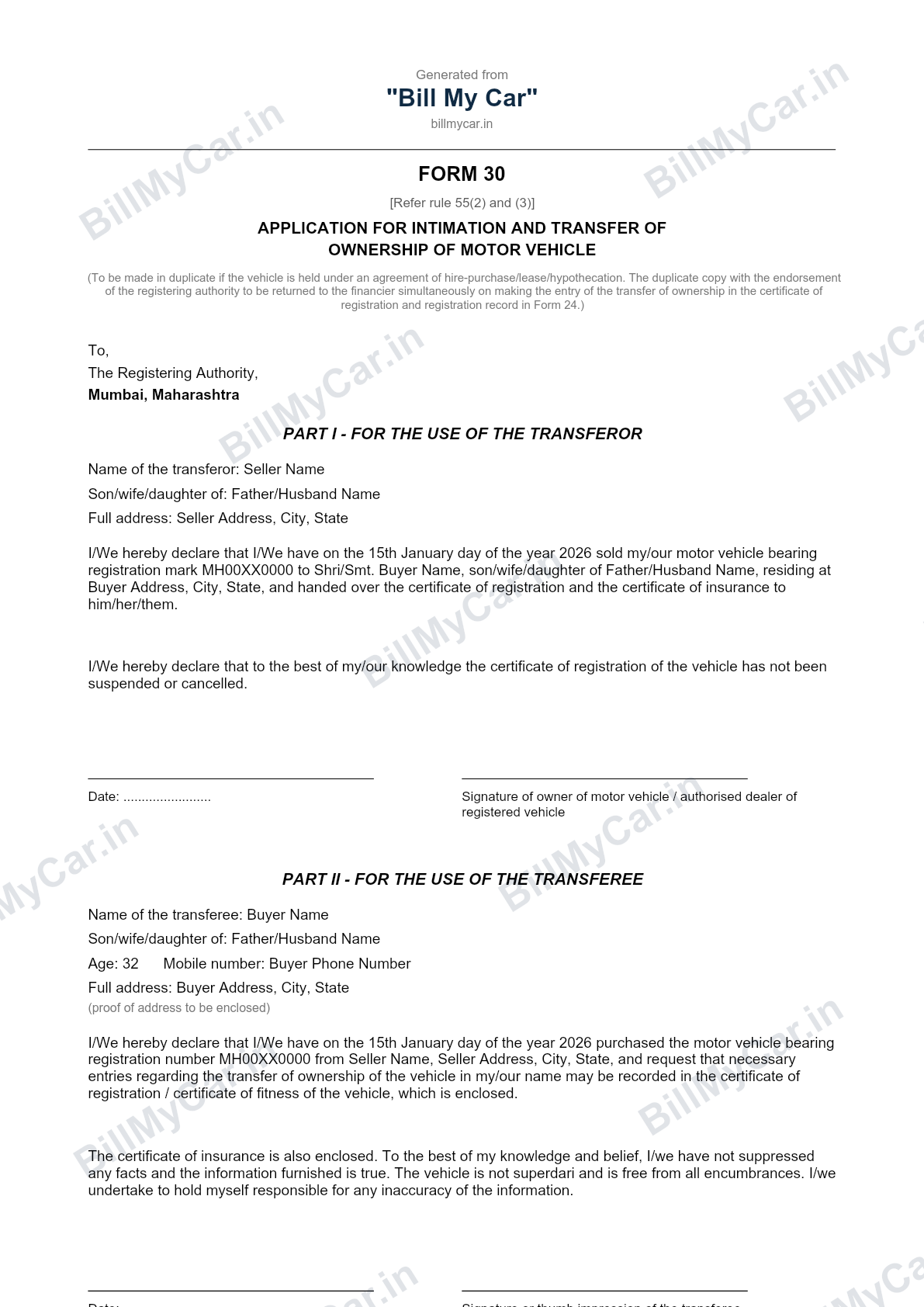
Fill and download Form 30 in seconds
- Fill Part I as the seller (transferor). Name, parentage, and full address of the person selling the vehicle.
- Fill Part II as the buyer (transferee). Name, parentage, age, mobile number, and full address of the person buying it.
- Add the vehicle and sale details. Registration number and date of sale, which carry across both parts.
- Download the PDF, then both parties sign. Tap download to get the ready-to-sign Form 30 straight to your device, print it, and have the seller sign Part I and the buyer sign Part II.
No account, no upload, no watermark on the document. It is a free, RTO compliant Form 30 you can submit alongside Form 29.
A free Form 30 format and template
The generator above is a ready-made Form 30 format, so you do not need to find a Word or PDF template or lay out the two parts by hand. It reproduces the official CMVR rule 55(2) and (3) structure: Part I for the transferor, Part II for the transferee, the financier consent section, and the signature blocks. Fill it in, download the PDF, and reuse the same format and template for your next sale.
Part I and Part II of Form 30: who signs where
Form 30 has two parts, and knowing which is which is what most people get stuck on:
- Part I, for the use of the transferor, is the seller's section. The seller fills in their name, parentage and address and signs it, declaring that they have sold the vehicle.
- Part II, for the use of the transferee, is the buyer's section. The buyer fills in their name, parentage, age, mobile number and address, and signs or gives a thumb impression, requesting that the RTO record the transfer in their name.
If the vehicle is financed, the financier signs a separate consent section. For a filled example showing exactly where each party signs, see how to fill Form 29 and Form 30.
What Form 30 is used for
Form 30, sometimes searched as what "Form 30 means", is the joint application to record a vehicle ownership transfer, filed under rule 55(2) and (3), Central Motor Vehicles Rules (CMVR), 1989. Part I is completed and signed by the seller (transferor), Part II by the buyer (transferee). If the vehicle is under hire-purchase, lease or hypothecation, the financier signs a consent section too.
Unlike Form 29, which only the seller signs, Form 30 needs both signatures. A missing Part II signature is one of the most common reasons an RTO sends a car transfer back. It is one of several papers a buyer and seller need together; see the full documents checklist for selling a used car and our step-by-step car ownership transfer guide for how Form 30 fits into the wider RTO process. Once it is submitted, you can check the RC transfer status on Parivahan. For a full walkthrough of who fills what and why on this specific form, see our Form 30 explained guide.
Form 30 or Form 29?
Form 29 and Form 30 are filed together, not as alternatives. Form 29 gives notice of the transfer, and Form 30 is the joint application that gets it recorded at the RTO.
| Form 29 | Form 30 | |
|---|---|---|
| Filed under | CMVR rule 55(1) | CMVR rule 55(2) and (3) |
| Signed by | Seller (transferor) only | Both seller and buyer |
| Purpose | Notice that a sale happened | Application to record the transfer |
For the full breakdown, read Form 29 vs Form 30: What's the Difference, or generate Form 29 free below.
Free RTO document generators from Bill My Car
Selling or buying a used vehicle usually needs more than one document. These are also free, no login needed:
Auto-fill Form 30 from your invoice next time
Filling Form 30 by hand works for a one-off car sale, but a dealer doing this every week ends up retyping the same registration number, buyer address and phone number across five different documents. Bill My Car auto-fills Form 29, Form 30, the delivery note, and your GST or non-GST invoice from a single entry, so nothing gets typed twice. Try Bill My Car free →
Auto-fill Form 30 from your invoice next time
Bill My Car turns one invoice into GST & non-GST bills, sale letters, Form 29, Form 30 and delivery notes, auto-filled and ready to download. Built for Indian used-car dealers.
Try Bill My Car free →Frequently asked questions
What is Part 2 of Form 30 (for the use of the transferee)?
Part II, headed for the use of the transferee, is the buyer's section of Form 30. The buyer fills in their name, parentage, age, mobile number and address, and signs or gives a thumb impression there. Part I is the seller's (transferor's) section.
Who is the transferee in Form 30?
The transferee is the buyer, the person the vehicle is being transferred to. They complete and sign Part II. The transferor is the seller, who completes and signs Part I.
Where do I sign on Form 30?
The seller signs Part I as the transferor, the buyer signs Part II as the transferee, and if the vehicle is financed the financier signs the consent section. See how to fill Form 30 for a filled sample showing exactly where each signature goes.
Is there a filled sample of Form 30?
Yes. The image above is a filled sample of Form 30. For a field-by-field walkthrough of Part I and Part II with a filled example, see our guide on how to fill Form 29 and Form 30.
How do I fill and download Form 30 in seconds?
Enter the transferor (Part I) and transferee (Part II) details in the generator above, then tap download. Form 30 is created as a PDF in your browser and saved to your device in seconds, ready to print and sign. No login, no upload.
How do I download Form 30 as a PDF?
Fill the fields in the generator above and tap Download. The Form 30 PDF is generated entirely in your browser and downloaded straight to your device. Nothing is uploaded or saved anywhere.
Is there a free Form 30 format or template?
Yes. The generator above is a free, ready-to-use Form 30 format and template with Part I and Part II laid out per the official CMVR format, so you do not need a separate Word or PDF template. Just fill it in and download.
Is this Form 30 PDF valid for RTO submission?
Yes. It follows the official, RTO compliant Form 30 format under rule 55(2) and (3) of the Central Motor Vehicles Rules (CMVR), 1989, with Part I for the transferor and Part II for the transferee. Fill it, both parties sign it, and submit it with Form 29.
Form 30 kaise bhare?
Upar diye gaye generator mein Part I (bechne wale) aur Part II (kharidne wale) ki details bharein aur PDF download karein. Koi login ya upload nahi, Form 30 seconds mein ready ho jaata hai, print aur sign ke liye taiyaar.
Do I need to log in or upload anything to use this?
No. Nothing you type is uploaded or saved anywhere. The PDF is generated entirely in your browser and downloaded straight to your device.
Who signs Form 30?
Both the seller and buyer sign Form 30, since it is a joint application. The seller signs Part I as the transferor and the buyer signs Part II as the transferee. If the vehicle is financed, the financier also signs the consent section.
Do I need Form 29 as well?
Yes. Form 29 gives notice of the transfer and Form 30 is the application to record it. RTOs need both together. See our Form 29 vs Form 30 guide, or use the free Form 29 generator below.