 Bill My Car
RTO & Ownership Transfer
Form 29 vs Form 30: What's the Difference?
For Car and Bike Dealers in India
Start free →If you are selling or buying a used car in India, you will hear about Form 29 and Form 30 together, and it is easy to mix them up. They are two different documents that do two different jobs, and you need both.
Here is the difference in plain terms.
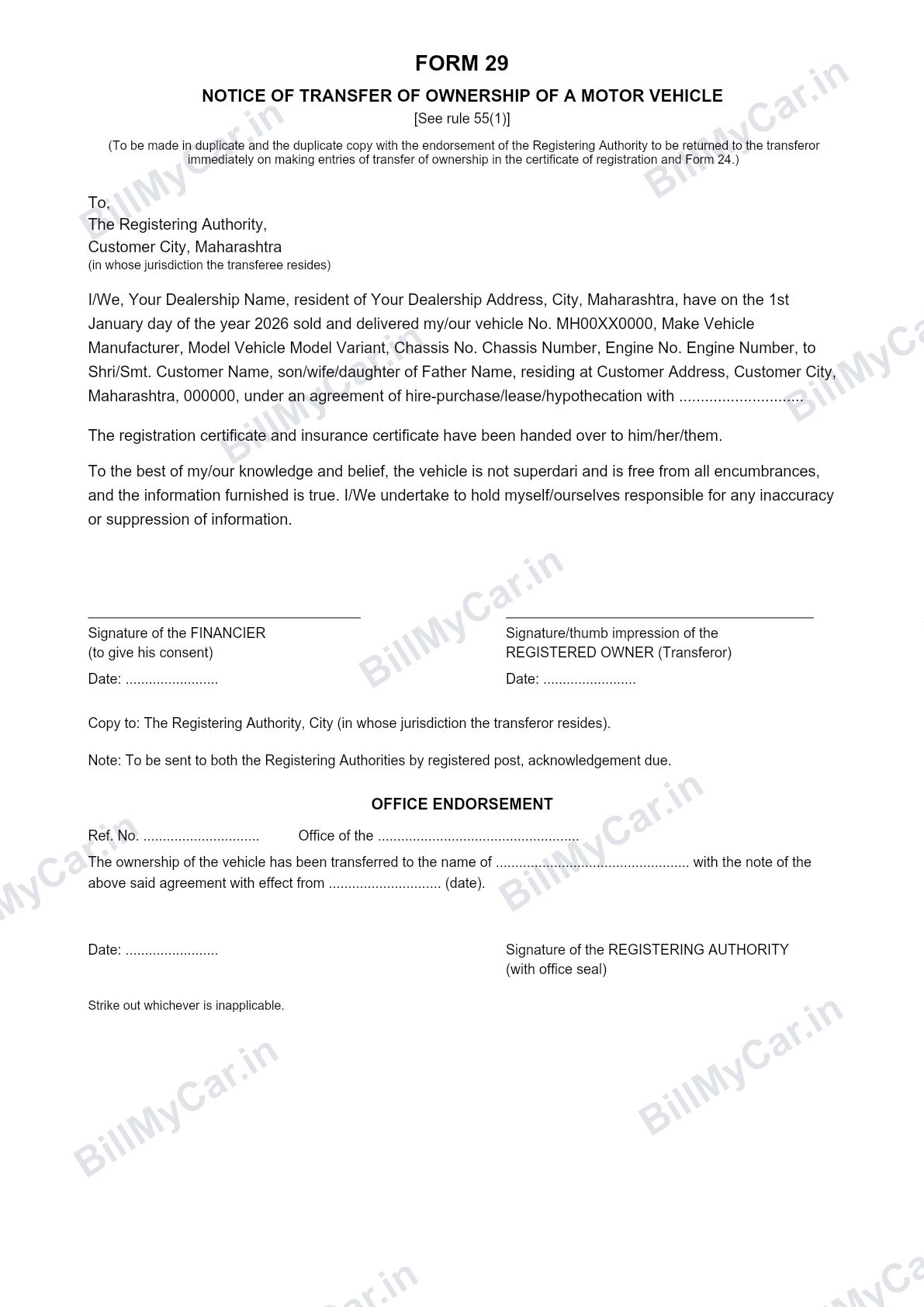
Form 29, the notice the seller gives. Sign in to BillMyCar.in and generate yours, auto-filled, in seconds.
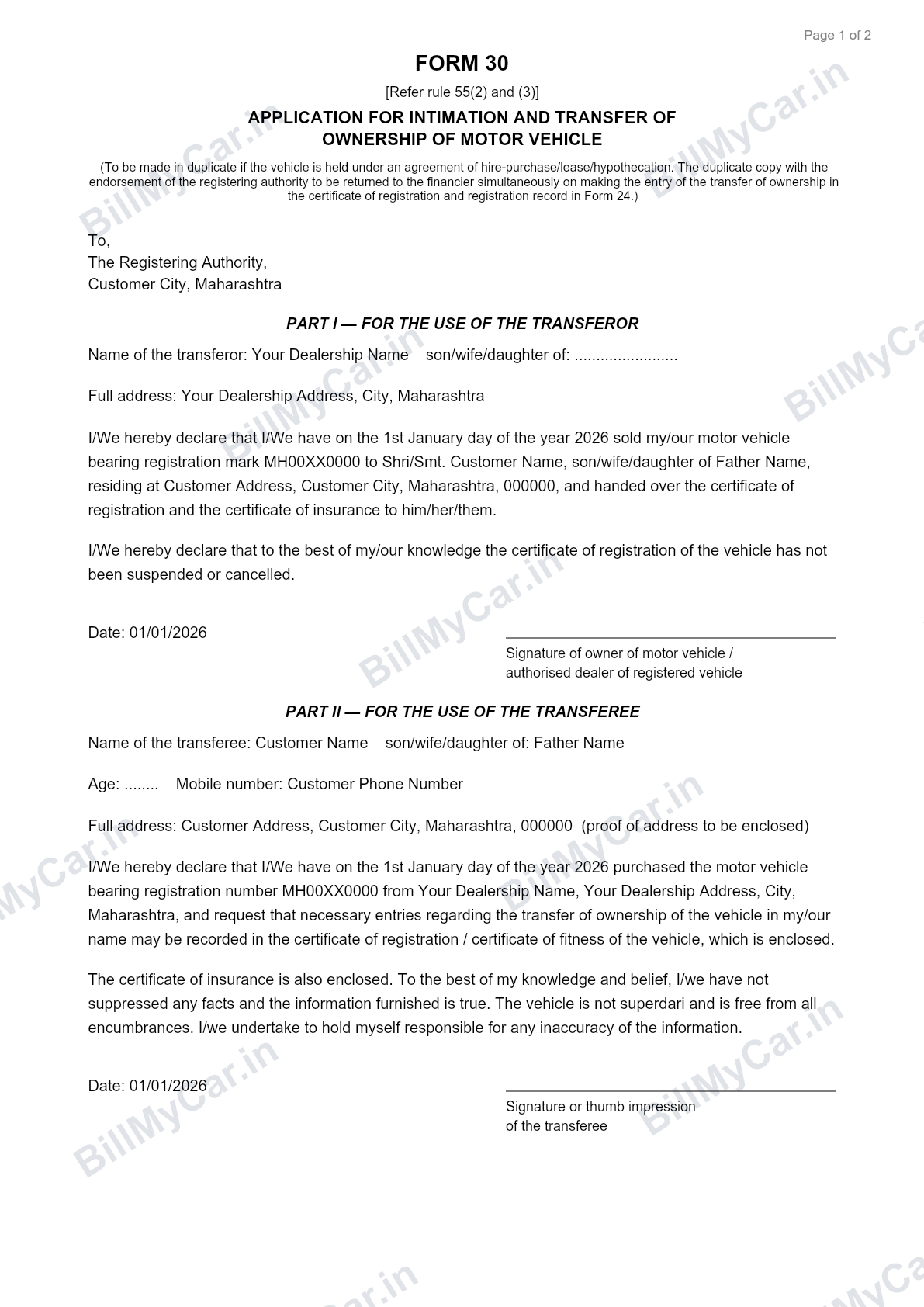
Form 30, the application the buyer files. Sign in to BillMyCar.in and generate yours, auto-filled, in seconds.
The one-line answer
- Form 29 is the seller's notice that ownership has been transferred.
- Form 30 is the application to officially record that transfer.
Form 29 announces the change. Form 30 requests the records be updated. Together they complete the ownership transfer.
Side-by-side comparison
| Form 29 | Form 30 | |
|---|---|---|
| Purpose | Notice of transfer of ownership | Application to record the transfer |
| Rule | CMV Rule 55(1) | CMV Rule 55(2) and (3) |
| Who signs | Seller (transferor) | Both buyer and seller |
| Copies (typical) | Two | One |
| Covers loan details | No | Yes (hypothecation section) |
Why two forms?
The system separates the two acts on purpose:
- The seller must notify the authority that they no longer own the vehicle. That is Form 29, and it protects the seller from future liability.
- The new owner must be recorded. That is Form 30, signed by both parties, with space for clearing any loan on the car.
Read each in depth: Form 29 explained and Form 30 explained.
What both forms have in common
Both require the same core vehicle data:
- Registration number
- Engine number and chassis number
- Buyer and seller names and addresses
- Date of transfer
Because the data overlaps, dealers end up typing it twice (plus again on the invoice and sale letter). That repetition is where errors creep in, and a single mismatch can bounce the whole file at the RTO.
Get them both, filled, in one step
Instead of filling Form 29, then Form 30, then checking that every number matches, capture the sale once and let both forms generate from the same data. No retyping, no mismatches, ready to sign.
Create both forms in one step
Bill My Car turns one invoice into GST & non-GST bills, sale letters, Form 29, Form 30 and delivery notes, auto-filled and ready to download. Built for Indian used-car dealers.
Try Bill My Car free →Frequently asked questions
Do I need both Form 29 and Form 30?
Yes. They work as a pair. Form 29 is the notice of transfer and Form 30 is the application to record it. The RTO needs both to process a sale-based ownership change.
Which form does the buyer sign?
The buyer signs Form 30 (the joint application). Form 29 is signed by the seller as the notice of transfer, with the buyer listed as the transferee.
Are Form 29 and Form 30 the same across India?
They are central forms under the Motor Vehicles Rules, so the format is consistent nationwide, though submission steps and copy counts can vary by state RTO.