 Bill My Car
RTO & Ownership Transfer
Form 29 Explained: What It Is & How to Fill It (Free Format)
For Car and Bike Dealers in India
Start free →When you sell a used car in India, Form 29 is one of the two RTO documents that make the ownership transfer official. If it's missing or filled wrong, the buyer's name change gets stuck, and an untransferred car remains your legal liability.
Here's exactly what Form 29 is, who fills it, and how to produce it without retyping the whole car's history.
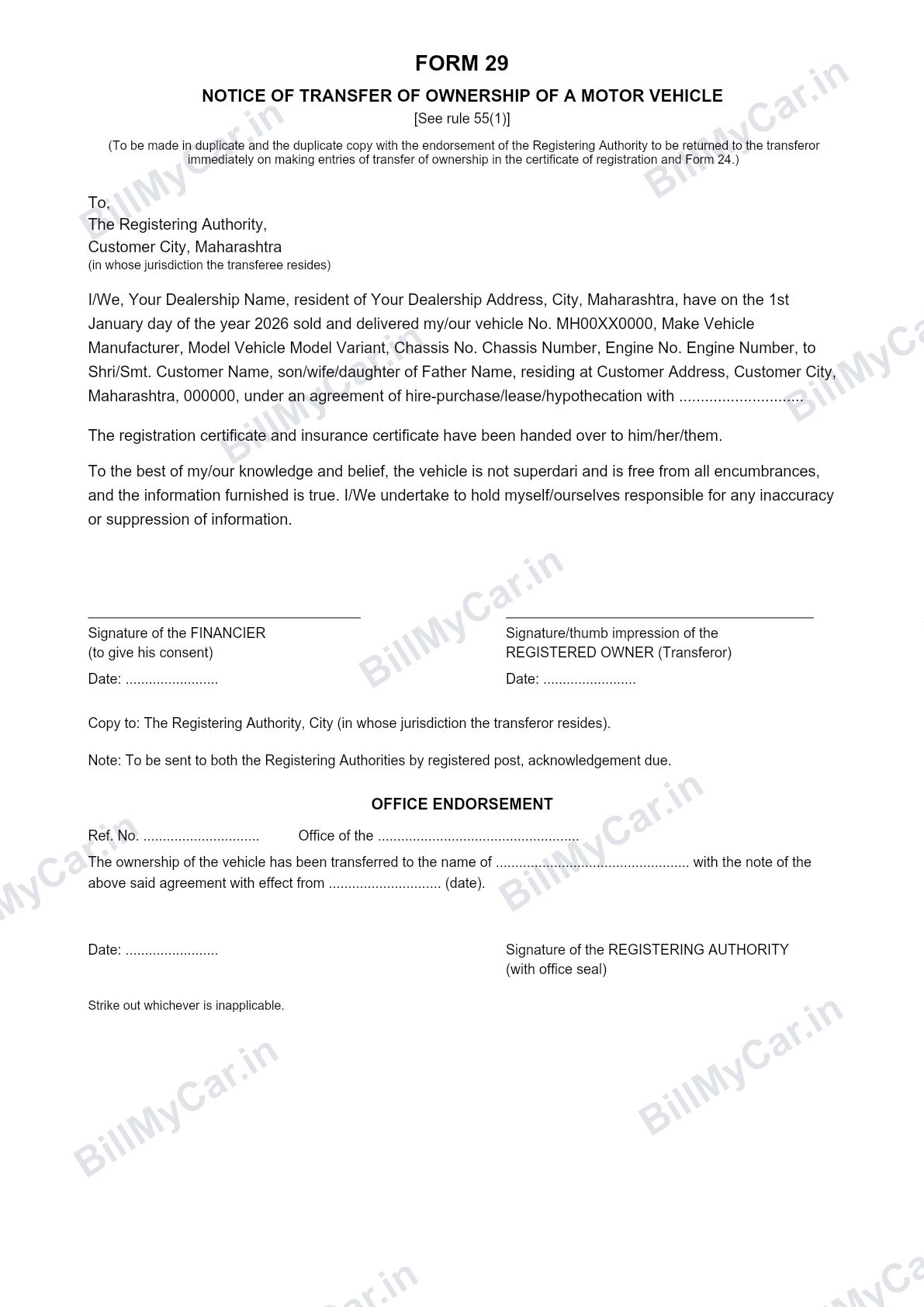
A filled sample of Form 29 generated with Bill My Car. Sign in to BillMyCar.in and generate yours, auto-filled, in seconds.
What is Form 29?
Form 29 is the notice of transfer of ownership of a motor vehicle, prescribed under the Central Motor Vehicles Rules (Rule 55). In plain terms: it's the seller formally telling the RTO, "I have handed this vehicle over to this buyer."
It is filed together with Form 30, Form 29 gives notice, Form 30 applies to record it.
When do you need it?
Any time ownership of a registered vehicle changes hands:
- A dealer selling a pre-owned car to a customer
- A private individual selling their car
- Transfer due to sale, gift, or inheritance
What information goes on Form 29
Form 29 needs accurate vehicle and party details:
- Registration number of the vehicle
- Make, model and class of vehicle
- Engine number and chassis number
- Name and address of the transferor (seller)
- Name and address of the transferee (buyer)
- Date of transfer
- Seller's signature
The engine and chassis numbers are the fields people most often get wrong or leave blank. They must match the RC exactly, capture them once on your sale invoice and reuse them.
How to fill Form 29, step by step
- Enter the vehicle's registration number and class.
- Fill the maker's name, month/year of manufacture.
- Enter the engine number and chassis number exactly as on the RC.
- Fill the buyer's (transferee's) full name and address.
- Enter the date of transfer of ownership.
- The seller signs as the transferor.
- Make the required number of copies (commonly two) for the RTO.
Documents usually filed alongside Form 29
- Form 30 (application for transfer)
- Copy of the RC
- Valid insurance certificate
- PUC certificate
- Proof of sale (your used-car invoice)
- ID/address proof of buyer and seller
For the complete list, see documents required to sell a used car.
Generate Form 29 free
If you just need the form now, use our free Form 29 RTO generator: fill in the seller, buyer and vehicle details and download a ready-to-sign PDF, with no login. Since Form 29 and Form 30 are always filed together, you can generate Form 30 free the same way.
The dealer problem: typing it all again
A dealer fills the buyer name, vehicle reg, chassis and engine numbers on the invoice, then types the same details again on Form 29, again on Form 30, and again on the sale letter. That's four times for one sale, and every retype is a chance for a mismatch that bounces at the RTO.
The fix is to capture the deal once and let Form 29 and Form 30 fill themselves from it.
Generate Form 29 free from your invoice
Bill My Car turns one invoice into GST & non-GST bills, sale letters, Form 29, Form 30 and delivery notes, auto-filled and ready to download. Built for Indian used-car dealers.
Try Bill My Car free →Frequently asked questions
How many copies of Form 29 are needed?
Two copies of Form 29 are usually submitted to the RTO, one is retained by the registering authority and one is forwarded to the buyer's RTO if the vehicle is moving jurisdictions. Confirm the exact count with your local RTO.
Who signs Form 29, buyer or seller?
Form 29 is the seller's notice of transfer, so the seller (transferor) signs it. The buyer's details are filled in as the transferee.
Is Form 29 the same as Form 30?
No. Form 29 is the seller's notice that ownership has been transferred. Form 30 is the formal application to record that transfer. They are filed together. See our Form 29 vs Form 30 guide.