 Bill My Car
Invoicing, GST & Billing
Used Car Invoice Format: GST vs Non-GST (Free Template)
For Car and Bike Dealers in India
Start free →If you sell pre-owned cars, the invoice is the one document you create on every single deal. Get the format right and the rest of the paperwork, Form 29, Form 30, the sale letter, flows from it. Get it wrong and you're inviting disputes, RTO delays and tax headaches.
This guide covers the correct used car invoice format for Indian dealers: the two types of bill (GST and non-GST), the exact fields each one needs, and a template you can copy.
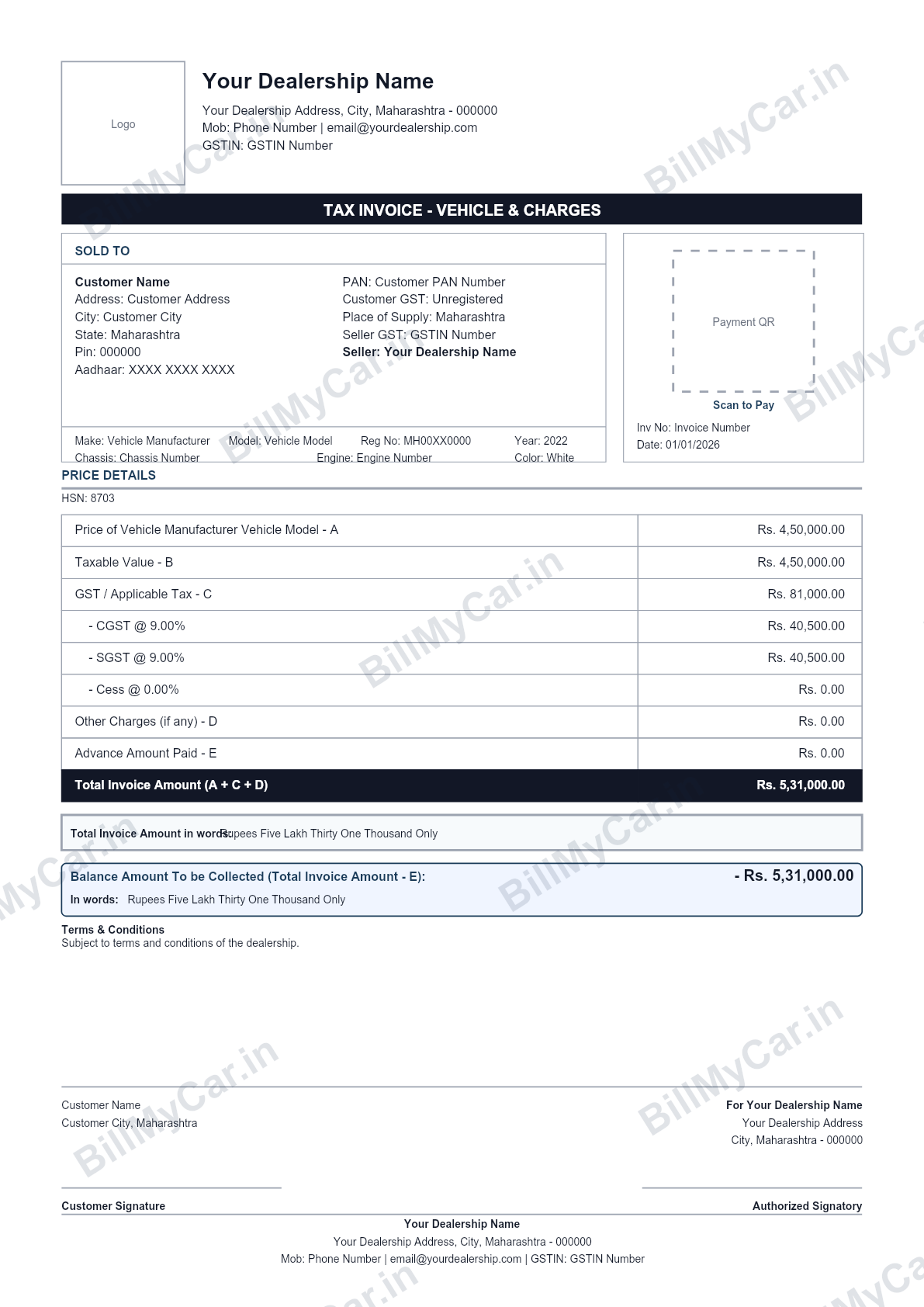
The GST invoice format. Sign in to BillMyCar.in and generate yours, auto-filled, in seconds.
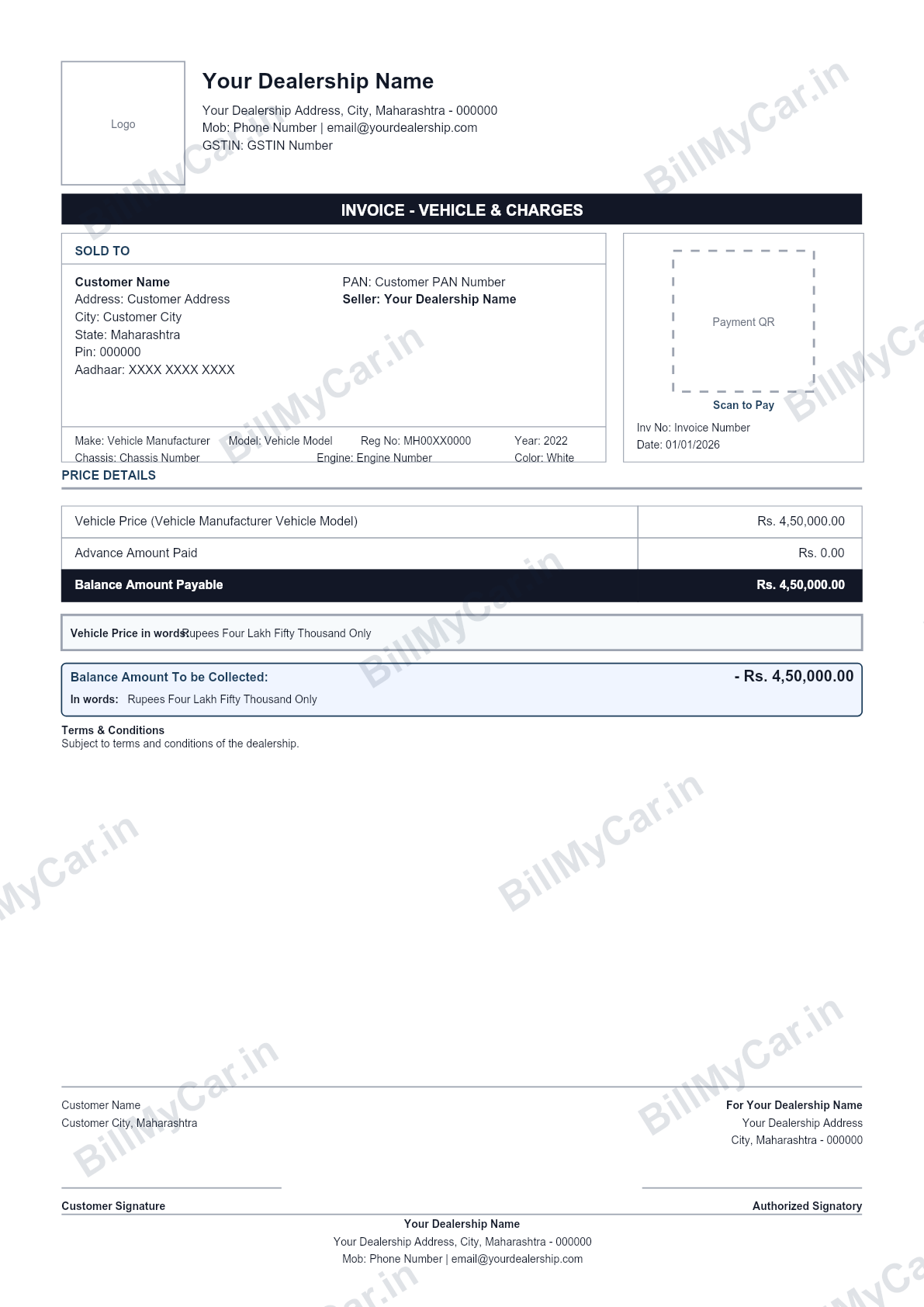
The non-GST invoice format. Sign in to BillMyCar.in and generate yours, auto-filled, in seconds.
The two kinds of used-car invoice
There are two formats, and which one you use depends on whether you're GST-registered:
| GST tax invoice | Non-GST sale invoice | |
|---|---|---|
| Who issues it | GST-registered dealer | Private seller / unregistered dealer |
| Tax shown | CGST + SGST on the margin | No tax breakup |
| Best for | Registered dealerships | Casual / one-off sales |
| Also called | Tax invoice | Bill of sale, cash memo |
Most registered used-car dealers bill under the GST margin scheme, where tax applies only to your profit margin, not the full car value. We explain that in detail in our GST on used cars guide and the margin scheme breakdown.
Fields every used-car invoice must have
Whether GST or non-GST, a clean invoice includes:
Seller (dealer) details
- Dealership name, address, phone
- GSTIN (for GST invoices) and PAN
Buyer details
- Full name and address
- Phone number
- ID reference (Aadhaar / PAN), optional but recommended
Vehicle details
- Registration number
- Make, model and variant
- Year of manufacture
- Chassis number and engine number
- Colour and kilometres driven
Sale details
- Invoice number and date
- Sale price (and, for GST, the taxable margin + CGST/SGST)
- Payment received / balance
- Signature of dealer and buyer
The vehicle's chassis and engine numbers matter more than people think, they carry straight into Form 29 and Form 30 for the RTO transfer. Capture them once on the invoice and you never retype them.
GST invoice format (margin scheme)
A margin-scheme tax invoice shows the tax on your margin only:
Sale price (agreed)          ₹ 5,20,000
Purchase price               ₹ 5,00,000
Margin (taxable value)       ₹   20,000
CGST @ 9%                     ₹    1,800
SGST @ 9%                     ₹    1,800
Total payable                ₹ 5,23,600
Note: GST rates and applicability change over time and can vary by vehicle category. Always confirm the current rate for your case.
Non-GST sale invoice format
Simpler, no tax rows, just the agreed amount:
Vehicle (reg, make/model)    MH12AB1234, Honda City 2019
Agreed sale price            ₹ 5,20,000
Advance received             ₹   50,000
Balance on delivery          ₹ 4,70,000
Free template, what to copy
Use this skeleton for either format:
- Header: dealership name, address, GSTIN/PAN, logo
- Invoice no. + date
- Bill to: buyer name, address, phone
- Vehicle block: reg no, make/model/variant, year, chassis, engine, KM
- Amount block: price (+ margin and CGST/SGST if GST)
- Payment: received / balance
- Signatures: dealer + buyer
Common mistakes to avoid
- Missing chassis/engine numbers, you'll need them again for Form 29/30, so capture them now.
- No invoice number sequence, makes your books impossible to audit.
- Charging GST on the full price instead of the margin (for margin-scheme dealers).
- No buyer signature, weakens the document if a dispute arises.
- Hand-writing every bill, slow, error-prone, and the details don't carry into your other forms.
Do it in one step instead
Typing the same buyer and vehicle details onto an invoice, then again onto a sale letter, then again onto Form 29 and Form 30 is where dealers lose hours every week. Capture the deal once and let the documents generate themselves.
Make a used-car invoice in 60 seconds
Bill My Car turns one invoice into GST & non-GST bills, sale letters, Form 29, Form 30 and delivery notes, auto-filled and ready to download. Built for Indian used-car dealers.
Try Bill My Car free →Frequently asked questions
Is a bill compulsory when selling a used car?
Yes. A proper invoice or bill of sale is your proof that the vehicle changed hands, for what amount, and on what date. It protects both the dealer and the buyer, and it is needed alongside Form 29 and Form 30 for the RTO ownership transfer.
Do I need to charge GST on a used car?
Only GST-registered dealers charge GST, and most use the margin scheme, GST is paid only on the dealer's margin (sale price minus purchase price), not the full vehicle value. A private seller or an unregistered dealer issues a non-GST sale invoice.
What is the difference between a GST invoice and a sale letter?
A GST invoice is the tax document showing the price and tax breakup. A sale letter (or delivery note) is a plain-language declaration that ownership and possession have transferred. Many dealers issue both.