 Bill My Car
Car Bills & Invoices
Car Bill Invoice: The Complete Guide for Indian Dealers (2026)
For Car and Bike Dealers in India
Start free →Every used-car deal produces paperwork. The car bill invoice sits at the centre of it. Get this document right and everything else, the sale letter, the RTO forms, the GST return, flows from it. Get it wrong and you risk disputes, tax problems, and delays at the RTO.
This guide covers everything an Indian used-car dealer needs to know about a car bill invoice: what it is, the types, what fields every invoice must include, the correct format, common mistakes, and how digital invoicing saves hours every week.
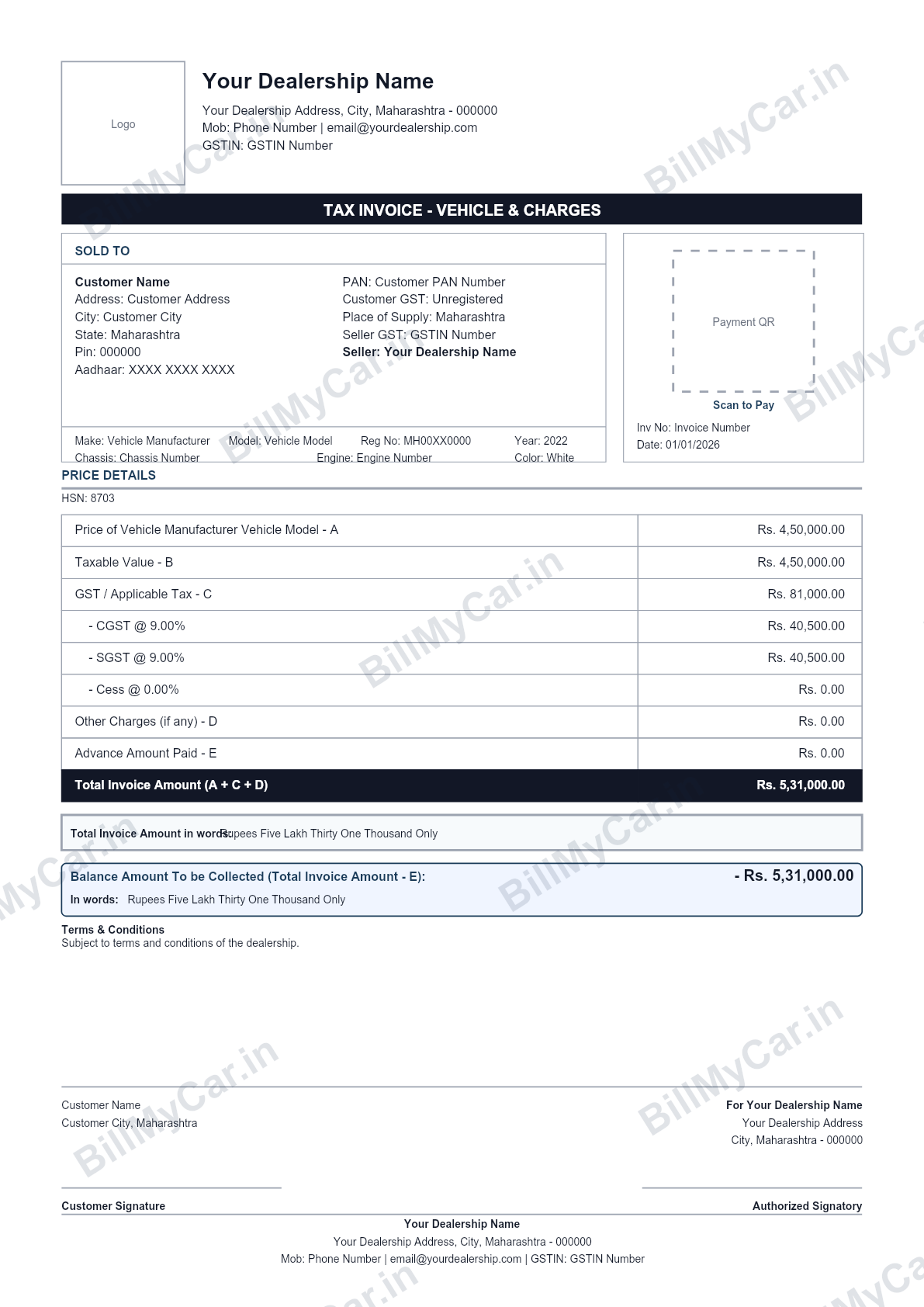
A car bill invoice generated with Bill My Car. Sign in to BillMyCar.in and generate yours, auto-filled, in seconds.
What is a car bill invoice?
A car bill invoice is the formal document issued by a seller to a buyer when a vehicle is sold. It records:
- Who sold the car (the dealer or private seller)
- Who bought it (the buyer)
- Which car (registration, make, model, chassis, engine)
- For how much (the sale price and, if GST applies, the tax breakup)
- When (the date of sale)
It is the official proof of the transaction. Without it, the buyer cannot begin the ownership transfer at the RTO and neither party has a clear record of the deal.
Why a car bill invoice matters
Legal proof. If a dispute arises, the invoice is the first document any court, insurer, or RTO will ask for. It establishes that the sale happened, at what price, and on what date.
Tax compliance. GST-registered dealers must issue a tax invoice for every sale. The invoice is the base for your GST returns and audit trail.
RTO transfer. The buyer needs the invoice to initiate the name transfer via Form 29 and Form 30. An incomplete invoice slows the process down.
Protecting the seller. Once the invoice is signed and dated, any traffic challans or fines on the vehicle after that date belong to the new owner, not to you.
Types of car bill invoice
Not all car invoices look the same. The format depends on your GST registration status.
GST tax invoice
Issued by a GST-registered used-car dealer. It shows:
- Your GSTIN
- The taxable margin (sale price minus purchase price)
- CGST and SGST on that margin at 9% each (total 18%)
Most registered dealers use the margin scheme, so GST is not charged on the full sale price but only on the profit. See the 18% GST on used cars guide and the margin scheme explained for the full calculation.
Non-GST sale invoice (cash memo)
Issued by a private seller or a dealer who is not GST-registered. No tax rows, just the agreed amount. Simple, but legally just as binding. See the non-GST cash memo format for a ready template.
| GST tax invoice | Non-GST invoice | |
|---|---|---|
| Who issues it | Registered dealer | Private seller / unregistered dealer |
| Tax rows | CGST + SGST on margin | None |
| GSTIN shown | Yes | No |
| When needed | Always for registered dealers | All other cases |
Key components of a car bill invoice
Whether GST or non-GST, every car bill invoice needs these fields.
Seller details
- Dealership or seller name
- Full address and phone number
- GSTIN and PAN (required for GST invoices)
Buyer details
- Full name and address
- Phone number
- Identity reference (Aadhaar/PAN), recommended for high-value transactions
Vehicle details
This block is the most important and the most often incomplete.
- Registration number
- Make, model, variant
- Year of manufacture
- Chassis number
- Engine number
- Colour and odometer reading (kilometres)
The chassis and engine numbers on the invoice must match exactly what appears on the RC. They carry forward directly into Form 29 and Form 30, so any mismatch causes a rejection at the RTO.
Sale details
- Invoice number (sequential, never duplicated)
- Date of sale
- Sale price
- For GST invoices: purchase price, margin, CGST amount, SGST amount
- Payment received and balance, if any
- Signatures of both seller and buyer
Correct car bill invoice format
Here is the layout that covers every requirement.
Header block Dealership name, logo, address, phone, GSTIN (if registered), PAN
Invoice reference Invoice No: BMC-2026-0042 Date: 28 June 2026
Seller [Dealer name, address, phone, GSTIN]
Buyer [Buyer name, address, phone, optional ID reference]
Vehicle Reg. No: MH12AB1234 Make/Model: Maruti Swift Dzire VXi Year: 2021 | Colour: Red Chassis: MA3FJEB1S00100000 Engine: K12MN1234567 KM: 38,000
Amount (GST invoice example)
| Item | Amount |
|---|---|
| Purchase price | Rs 4,00,000 |
| Selling price | Rs 4,20,000 |
| Taxable margin | Rs 20,000 |
| CGST @ 9% | Rs 1,800 |
| SGST @ 9% | Rs 1,800 |
| Total payable | Rs 4,23,600 |
Payment Advance received: Rs 50,000 Balance on delivery: Rs 3,73,600
Signatures For [Dealer name]: ________ Buyer (with date): ________
Common mistakes to avoid
Missing chassis and engine numbers. These are mandatory for the RTO transfer. Leave them out and the buyer will be back at your door.
No sequential invoice numbers. Jumping or repeating invoice numbers flags your books for audit. Use a simple series: BMC-001, BMC-002 or by year.
Charging GST on the full sale price. Registered dealers under the margin scheme pay tax only on the margin. Charging 18% on the full Rs 4,20,000 instead of the Rs 20,000 margin means overcharging the buyer and overpaying the government.
Buyer signature missing. An unsigned invoice is a one-sided document. Always get the buyer to sign and date it.
Retyping details across documents. Typing the same chassis number and buyer name onto the invoice, then the sale letter, then Form 29, then Form 30 is how errors creep in. Capture it once and generate all documents from the same entry.
The full set of sale documents
The invoice does not travel alone. A complete used-car handover in India includes:
| Document | Purpose |
|---|---|
| Car invoice (this guide) | Financial proof of the transaction |
| Sale letter | Confirms ownership passed to the buyer |
| Delivery note | Confirms physical possession and what was handed over |
| Form 29 | Seller's notice of transfer to the RTO |
| Form 30 | Buyer's application for ownership transfer |
| Buyer undertaking | Buyer accepts responsibility for challans, transfer timeline, etc. |
Paper vs digital invoices for Indian dealers
Paper invoices are still common at small dealerships, but they create real problems:
- Every new deal means rewriting the same vehicle and buyer details from scratch
- Handwriting errors on chassis or engine numbers cause RTO rejections
- Finding an old invoice months later takes a filing cabinet and patience
Digital invoices solve all of this. They carry the same legal weight, print to A4 for the buyer's records, and let you reuse the same deal data across every other document.
The practical step up from paper: a dedicated tool like Bill My Car that takes one entry and produces the GST invoice, sale letter, delivery note, and RTO forms together, all correctly filled and print-ready.
Do it from one entry
Capture the vehicle details, buyer details, and sale amount once. Bill My Car generates the invoice with correct GST or non-GST format and carries the same data into every other document automatically, no retyping, no mismatched chassis numbers.
Create your car bill invoice in seconds
Bill My Car turns one invoice into GST & non-GST bills, sale letters, Form 29, Form 30 and delivery notes, auto-filled and ready to download. Built for Indian used-car dealers.
Try Bill My Car free →Frequently asked questions
What is a car bill invoice?
A car bill invoice is the document a seller issues to a buyer when a vehicle changes hands. It records the vehicle details, sale price, tax (if GST applies), and the identities of both parties. It is the primary proof of the transaction.
Is a car bill invoice the same as a sale letter?
No. The invoice is the financial document that shows the price and tax. The sale letter (or delivery note) confirms that the car was handed over. Dealers usually issue both. See our comparison of bill vs sale letter vs invoice.
Do I need a GST invoice for every used car I sell?
Only if you are a GST-registered dealer. Unregistered sellers issue a plain non-GST bill. Registered dealers use a GST tax invoice under the margin scheme, where tax is charged on the profit margin, not the full sale price.
What is the margin scheme on a used car invoice?
Under the GST margin scheme, the registered dealer pays 18% GST only on the difference between the selling price and the purchase price. If you buy for Rs 4,00,000 and sell for Rs 4,20,000, GST is 18% of Rs 20,000, which is Rs 3,600.
Can I create a car bill invoice digitally?
Yes, and it is the faster way. Digital invoices reduce manual errors, carry the same legal weight as paper, and let you reuse the vehicle and buyer details across the sale letter, delivery note, and Form 29 and 30 without retyping anything.
What information is included in a car bill invoice?
Seller details (dealership name, address, GSTIN or PAN), buyer details (name, address, phone, PAN for cash above Rs 2 lakh), the invoice number and date from a consecutive series, the vehicle identity (registration number, make, model, year, colour, odometer, chassis number, engine number), the price in figures and words, the GST breakup if applicable, payment mode and status, and signatures of both parties.
Why is a car bill invoice important?
Three reasons: it is the legal proof of the transaction if a dispute, challan or notice surfaces later; it is the record GST law requires a registered dealer to keep for at least 72 months; and it feeds the RTO transfer, since the buyer needs it to file Form 30 and update insurance. Without an invoice, the sale effectively has no paper existence.
How do I create a car bill invoice?
Three ways: hand-write it in a bill book (slow, error-prone, fades), build a Word or Excel template (better, but every document is retyped), or use car billing software like Bill My Car, where the buyer and vehicle are entered once and the invoice generates in seconds together with the sale letter, delivery note and RTO forms.
What are the types of car bill invoices?
By tax treatment: a GST tax invoice (registered dealers, margin scheme, HSN 8703) and a non-GST cash bill (unregistered dealers and private sellers), plus the buyer copy dealers often issue alongside. By purpose, garages also issue service invoices and rental companies rental invoices, but a vehicle SALE always needs the sale invoice type.
What are the common mistakes to avoid in a car bill invoice?
Wrong or missing chassis and engine numbers (bounces the RTO transfer), GST charged on the full price instead of the margin, broken or duplicate invoice numbering, the amount missing in words, no payment mode recorded, and the buyer's signature missing. Each of these turns up later as a dispute or an audit query.
How do I ensure accuracy in a car bill invoice?
Copy the registration, chassis and engine numbers character by character from the RC, never from memory; let software compute the GST; keep one sale date across the invoice, sale letter and forms; and generate all documents from a single entry so they cannot disagree.
How should I store car bill invoices?
Digitally, in storage you own, organised per deal. GST law requires records for 72 months; ownership disputes can surface even later. Bill My Car saves every invoice PDF to the dealer's own Google Drive automatically, so the bill for any vehicle is a search away years later.
What is the future of car bill invoicing in India?
Less typing and faster delivery: sale details captured once generating every document, invoices shared to the customer's WhatsApp as a PDF in one tap, and records living in the dealer's own cloud storage. The direction is fewer manual steps between agreeing a deal and having compliant paperwork.