 Bill My Car
RTO & Ownership Transfer
Form 34: Adding Hypothecation to RC When the Buyer Takes a Car Loan
For Car and Bike Dealers in India
Start free →Form 34 is the application for addition of hypothecation under the Central Motor Vehicles Rules, 1989 [Rule 60]. When a buyer finances the purchase of a vehicle through a bank or NBFC, the lender requires their name to be recorded on the RC as the hypothecatee (the entity holding the lien). Form 34 is the document that triggers that update at the RTO.
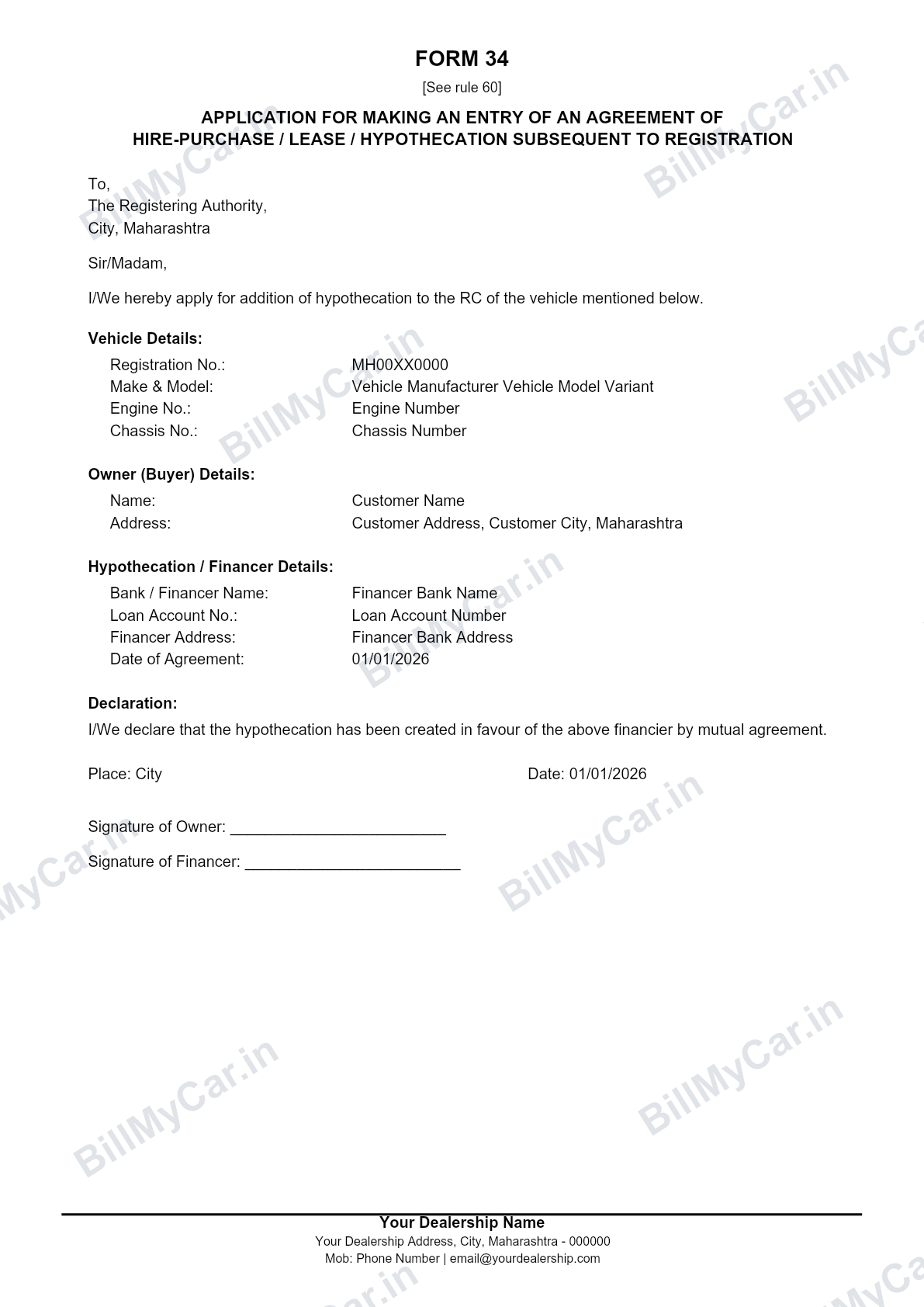
A filled sample of Form 34 generated with Bill My Car. Sign in to BillMyCar.in and generate yours, auto-filled, in seconds.
When is Form 34 required?
Form 34 is required any time a vehicle is purchased with a loan and the financer wishes to record their security interest on the RC. This applies to both new and used vehicle purchases.
For used cars specifically: if a buyer is taking a loan from a bank to purchase a second-hand car, the seller or dealer must ensure the ownership transfer forms (Form 29 and Form 30) are filed first, and then the buyer and their bank file Form 34 to add the new hypothecation.
What information goes on Form 34?
- Registration number, engine number and chassis number
- Owner (buyer) name and address
- Financer name and branch address
- Loan account number and date of agreement
- Capacity of hypothecation (loan amount)
- Signatures of the owner and the financer
Documents required
- Form 34, signed by both the buyer and the financer
- Original RC book
- Loan sanction letter from the bank
- Valid insurance and PUC certificate
- Owner's address proof and ID
- Applicable RTO fees (varies by state)
How to file Form 34
- The buyer completes the loan agreement with the bank.
- The bank (or a representative) co-signs Form 34.
- Both parties submit Form 34 along with the RC and supporting documents at the RTO.
- The RTO updates the RC to show the financer's name.
- The buyer receives the updated RC (or it is mailed), confirming the hypothecation.
Many banks handle Form 34 filing on behalf of the buyer as part of their loan disbursement process. Confirm with your lender whether they will file it or whether you need to go to the RTO yourself.
Form 34 in the context of a used-car sale
For dealers, Form 34 comes up when a buyer is financing the purchase through a bank. The sequence is:
- Form 29 and Form 30 to transfer ownership from dealer to buyer.
- Form 34 (filed separately by buyer and their bank) to add hypothecation to the newly transferred RC.
The dealer's role ends at the ownership transfer. The buyer and bank handle Form 34 independently, though a well-prepared dealer will explain the requirement and provide the vehicle's chassis and engine numbers from the sale letter.
Form 34 vs Form 35
| Form | Purpose |
|---|---|
| Form 34 | Add hypothecation (new loan) |
| Form 35 | Remove hypothecation (loan fully paid) |
| Form 28 | No Objection Certificate for interstate transfers or existing loan cases |
Save time on the forms
Form 34, Form 29 and Form 30 all repeat the same registration, engine and chassis numbers. Bill My Car captures those once in an invoice and generates all pre-filled forms for the dealer's end of the paperwork stack.
Generate RTO forms in seconds
Bill My Car turns one invoice into GST & non-GST bills, sale letters, Form 29, Form 30 and delivery notes, auto-filled and ready to download. Built for Indian used-car dealers.
Try Bill My Car free →Frequently asked questions
What is Form 34 used for?
Form 34 is used to add a financer's (bank's) name to the Registration Certificate when a vehicle purchase is financed by a loan. It records that the bank has a lien on the vehicle.
Who submits Form 34?
Both the vehicle owner (buyer) and the financer (bank) must sign and submit Form 34 to the RTO where the vehicle is registered.
How long does it take to add hypothecation to the RC?
After submitting Form 34, the RTO typically updates the RC within 7 to 30 working days, depending on the state and RTO. Some states offer online submission through the Parivahan portal.