 Bill My Car
Invoicing and Billing
Sales Bill for a Car: The Dealership Format That Survives Audits and RTO Visits

For Car and Bike Dealers in India
Start free →A sales bill for a car is the dealership's official record of a vehicle sale. It sets out the bill number and date, the buyer's details, the full vehicle identity, the price with its GST treatment, and the signatures of both sides. For a used-car dealership, it is the paper bill book upgraded into a format that carries every field the RTO and GST law expect.
The format matters for a simple reason. A faded carbon copy, a broken bill-book sequence, or a bill nobody can locate can stall an RTO visit or an audit. A proper sales bill keeps the series intact, records the vehicle in full, and stays easy to find months later.
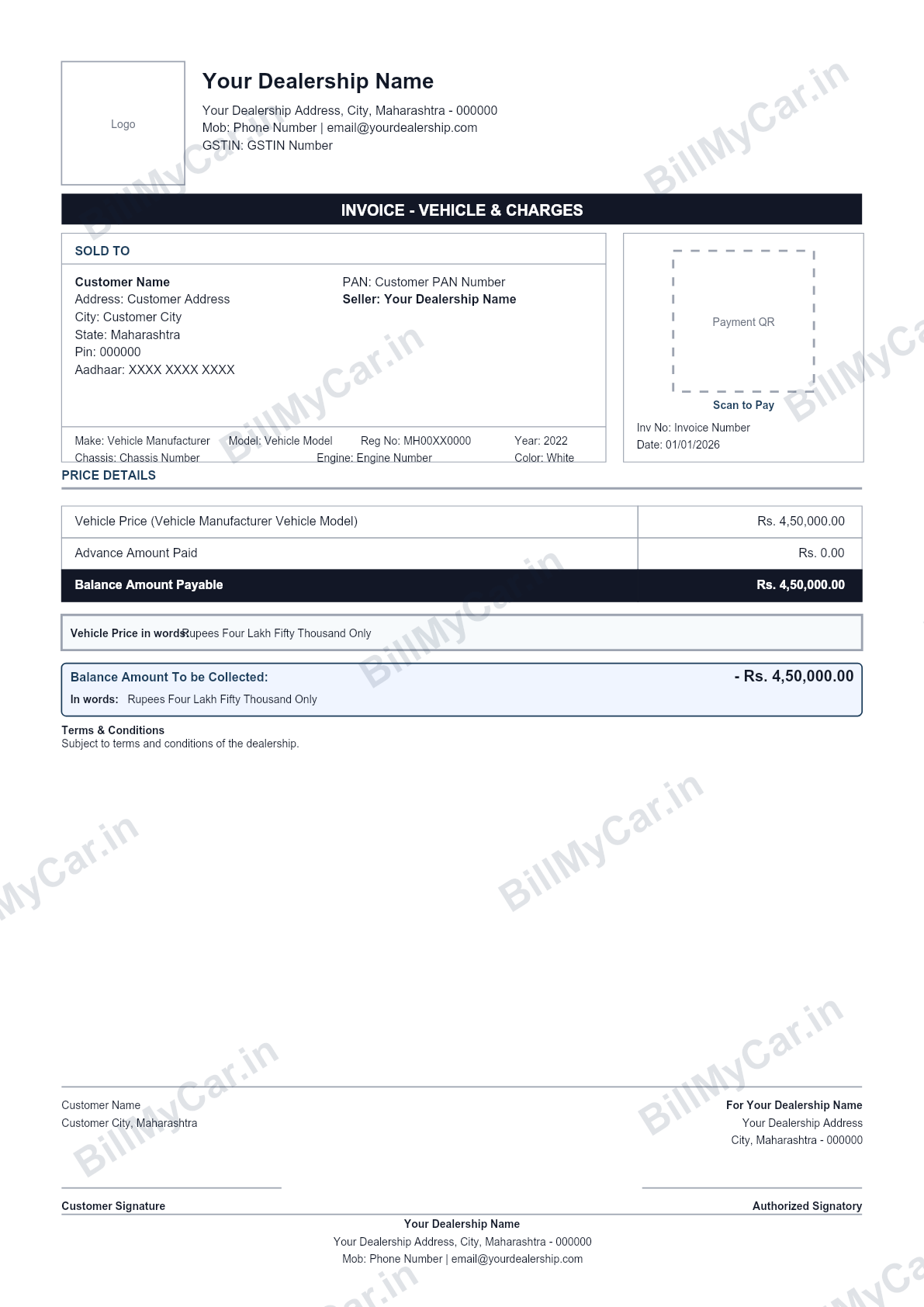
A dealership sales bill generated with Bill My Car. Sign in to BillMyCar.in and generate yours, auto-filled, in seconds.
What a car sales bill must include
A complete dealership sales bill has six parts:
- Bill number and date: a running series per financial year, never reused. This is your audit backbone.
- Dealership details: name, address, phone, and GSTIN or PAN, exactly as registered.
- Buyer details: name, address with PIN code, and phone; PAN for cash deals above Rs 2 lakh.
- Vehicle details: registration, make, model, variant, year, colour, odometer, chassis and engine numbers. This is what makes it a car sales bill; a generic bill has nowhere to record it.
- Price and payment: amount in figures and words, advance adjusted, balance due, and payment mode. GST-registered dealers show the margin-scheme tax split, calculated under Rule 32(5) of the CGST Rules, 2017.
- Signatures: your authorised signatory, and the buyer's acknowledgement.
How the sales bill fits with the rest of the paperwork
A sales bill on its own is only half the record. The same details must match, to the digit, across the sale letter, the delivery note, and Form 29 and Form 30. Most RTO rejections are not an error in a single document; they happen when two documents disagree. We cover this in full in dealership billing operations.
From a manually typed bill to a two-minute sales bill
Bill My Car replaces the paper bill book for used and new car dealerships alike. The series runs itself, the vehicle fields are built in, the GST margin calculation is automatic, and the sales bill is produced together with the sale letter, delivery note, and every RTO form from a single entry. Each PDF saves to your own Google Drive, so a bill from three years ago is one search away, on your phone or your desktop. Related reading: how to make a car sale invoice and car bill format.
Replace the bill book with two-minute billing
Bill My Car turns one invoice into GST & non-GST bills, sale letters, Form 29, Form 30 and delivery notes, auto-filled and ready to download. Built for Indian used-car dealers.
Try Bill My Car free →Frequently asked questions
What is a sales bill for a car?
The dealership's record of the sale transaction: bill number, date, buyer, complete vehicle identity, price with GST treatment, payment status and signatures. It is the document your bill book used to hold, upgraded with the vehicle fields the RTO and GST law expect.
Is a sales bill different from a tax invoice?
For a GST-registered dealer, the sales bill is issued as a tax invoice with HSN 8703 and margin-scheme GST. For an unregistered dealer, it is a plain sales bill with no tax lines. Same document, different tax treatment based on registration.
Should a dealership still use a physical bill book?
Bill books fail at the copy stage: carbon copies fade, sequences break when a book is misplaced, and nothing links the bill to the sale letter or transfer forms. A digital sales bill keeps the series automatically and files itself.
What bill number format should a dealership use?
Any consecutive, financial-year-scoped, never-reused series works. A readable pattern like BMC/2026-27/0042 makes audits painless. Separate series for GST and non-GST bills are allowed and sensible.