 Bill My Car
Running a Dealership
Vehicle Sale Agreement Format (Free Template for India)
For Car and Bike Dealers in India
Start free →A vehicle sale agreement is the document that spells out the full terms when a car changes hands: who is selling, who is buying, the price, the condition, and who is responsible from when. It protects both parties if anything is disputed later.
Here is the correct vehicle sale agreement format for India, with a free sample.
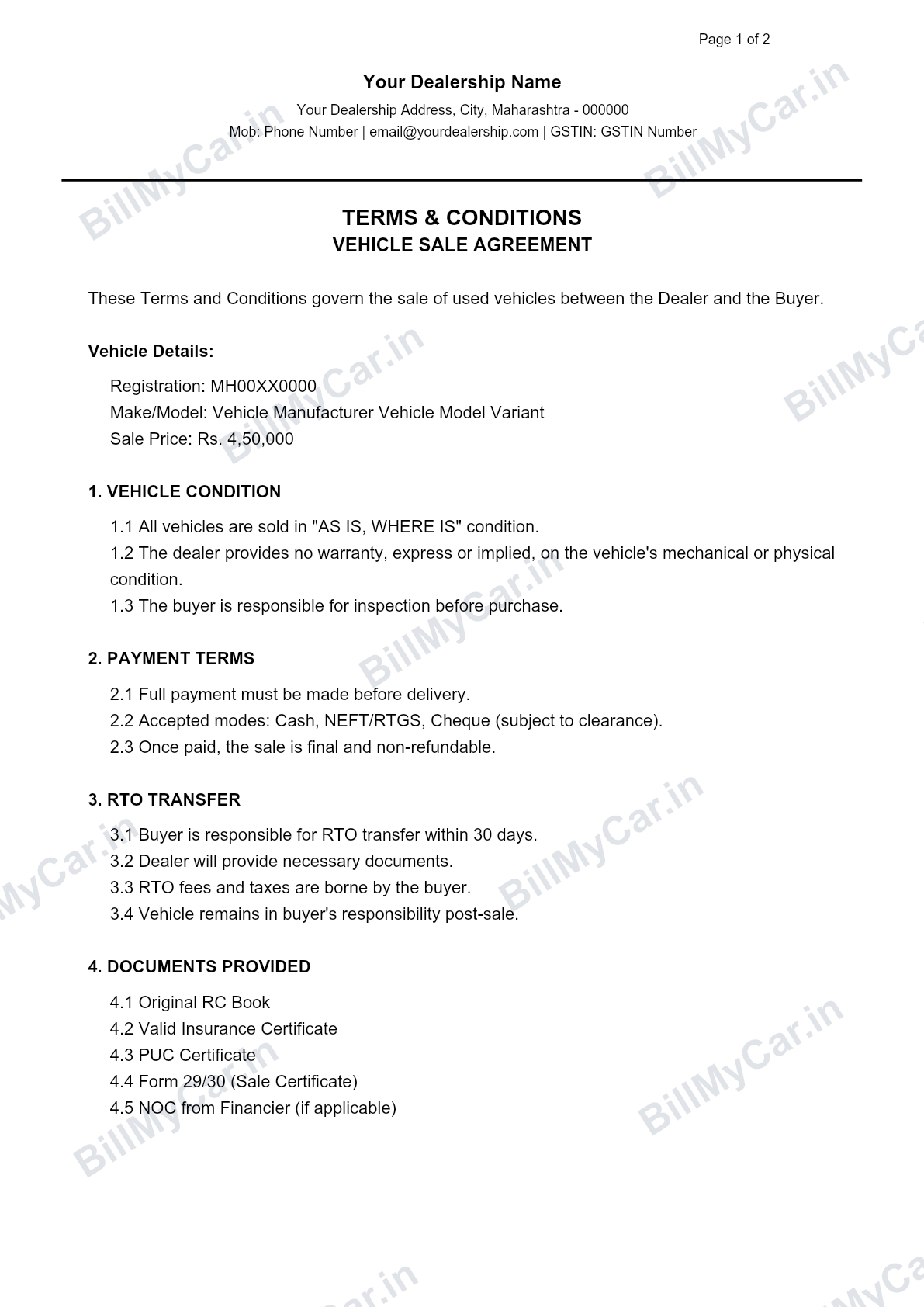
Sample terms and conditions of a vehicle sale agreement generated with Bill My Car. Sign in to BillMyCar.in and generate yours, auto-filled, in seconds.
When you need a sale agreement
- Higher-value sales where both sides want clear terms.
- Sales with conditions (payment in instalments, as-is condition, pending work).
- Any sale where you want a documented date of handover and transfer of liability.
For routine handovers, many dealers use a shorter sale letter instead. Both sit alongside the invoice and the RTO forms.
What a vehicle sale agreement must include
- Parties: seller and buyer names and addresses
- Vehicle: registration number, make/model/year, engine and chassis numbers, colour, KM
- Price: total amount, advance paid, balance and due date
- Condition: sold on an as-is basis, with any known issues noted
- Transfer of liability: the date from which the buyer is responsible for challans, fines and accidents
- RTO transfer: that both parties will complete Form 29 and Form 30
- Signatures: both parties, with witnesses if possible
Free sample format
This agreement is made on [date] between [Seller name], of [address] (the Seller), and [Buyer name], of [address] (the Buyer).
The Seller sells the vehicle bearing registration number [MH12AB1234], [make/model/year], engine number [...], chassis number [...], to the Buyer for a total consideration of Rs [amount].
The vehicle is sold on an as-is basis. Possession is handed over on [date], from which the Buyer is responsible for the vehicle, including any challans, fines and liabilities. Both parties agree to complete the RTO ownership transfer (Form 29 and Form 30).
Seller signature ________ Buyer signature ________ Witness ________
Tips
- Record the engine and chassis numbers exactly as on the RC, so they match Form 29 and Form 30.
- State the handover date clearly, as it sets when liability passes.
- Keep a signed copy and give one to the buyer.
Do the paperwork once
The buyer and vehicle details on the agreement are the same as on the invoice, sale letter and RTO forms. Capture the deal once in Bill My Car and generate the whole set, already filled, instead of retyping.
Generate your sale documents in seconds
Bill My Car turns one invoice into GST & non-GST bills, sale letters, Form 29, Form 30 and delivery notes, auto-filled and ready to download. Built for Indian used-car dealers.
Try Bill My Car free →Frequently asked questions
Is a vehicle sale agreement legally valid?
A signed sale agreement is strong evidence of the terms, parties and date of sale. It is not a replacement for the RTO ownership transfer (Form 29 and 30), but it protects both sides in a dispute. For high-value sales, get it notarised.
What is the difference between a sale agreement and a sale letter?
A sale agreement sets out the full terms and conditions of the sale. A sale letter is a shorter declaration that the vehicle and ownership have been handed over. Dealers often use the sale letter for everyday handovers.
Do I still need Form 29 and Form 30?
Yes. The agreement records the deal between the parties, while Form 29 and Form 30 are what actually update ownership at the RTO.